The best marker of success for biomedical engineering students isn’t always a grade or a test score – it’s the quality of collaboration between engineering and medical education departments.
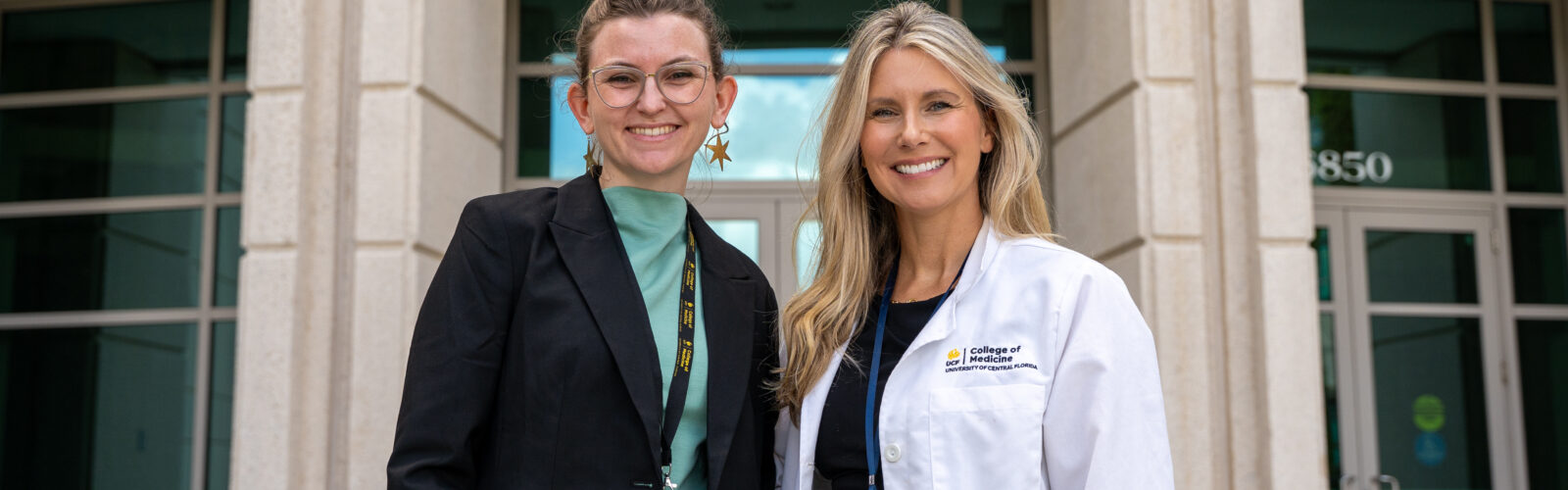
At UCF, the College of Engineering and Computer Science (CECS) and the College of Medicine (COM) have a close partnership that enables biomedical engineering students to study anatomy and physiology through hands-on learning and observation. This partnership is detailed in a recent journal article, “A Collaborative Anatomy Course for BME Graduate Students: An Institutional Longitudinal Case Study of Multidisciplinary Integration Using Labs and Assignments,” published in Biomedical Engineering Education, the official journal of the Biomedical Engineering Society. The article itself is a collaboration between CECS and COM researchers: Dr. Emily Bradshaw, associate professor of medicine; Alain Kassab, the director of the biomedical engineering program; and Luigi Perotti, associate professor of biomedical engineering.
“Our collaboration started five years ago,” Bradshaw says. “Drs. Kassab and Perotti wanted to design an interdisciplinary homework experience that has a hands-on component in the gross anatomy lab.”
Over the years, those homework experiences transformed into two courses, Biostructures I and Biostructures II, which allow biomedical engineering students to spend time in the COM labs where they can benefit from interactive experiences.
In the gross anatomy lab, they examine human anatomical donors and pathological specimens so they can see what various cardiovascular diseases look like or how a pacemaker is placed in the heart. They can also interact with the Anatomage Table, an advanced virtual dissection tool that displays a life-sized 3D rendering of the body. In the clinical skills lab, they can record EKGs, listen to heart sounds, perform echocardiograms, and evaluate high-fidelity mannequin patients.
Although these experiences sound like standard practice for biomedical engineering students, Bradshaw says they are unique to UCF’s M.S. in Biomedical Engineering.
“Many biomedical engineering students don’t get these types of experiences,” Bradshaw says. “The great thing is medical education infrastructure at UCF allows us to do different things and over time, the number of experiences we have been able to offer students has grown.”
Bradshaw notes that the hands-on experiences at COM can help students bring a different perspective to their homework or coursework.
“The students spend time in the microscopy lab to study histology and then do homework for Dr. Perotti, where he will have them look at images and heart measurements to calculate strain,” she says. “It’s a rich environment for them to learn.”
For Madisyn Messmore ‘24MS ’22, a biomedical engineering doctoral student, the Biostructures course has helped her grow as both an engineer and a student. Since completing the course, Messmore now serves as the graduate teaching assistant for Bradshaw. She said the experience helped her develop a deeper grasp of human anatomy than what is shown in textbooks and has made her a better biomedical engineer.
“While the idea of a cadaver lab can be daunting, having someone as respectful and knowledgeable as Dr. Bradshaw to guide you through the experience alleviates so much of the stress,” Messmore says. “Dr. Bradshaw cares a lot about her students and their education, and it shows in her course. She’s always searching for new ways to add current BME technology to make our experience relevant and regularly checks in with her students to ensure they are comfortable without any judgment.”
Another benefit of the course is that it allows engineering students to see how doctors are trained, Bradshaw says. When they see the equipment that is used to train physicians, such as hi-fidelity manikins that simulate human anatomy and physiological responses, they realize they can spend their career developing and improving this type of equipment.
The interdisciplinary nature of the course is something that Bradshaw enjoys. She hopes to work with more of the biomedical engineering faculty in the future and says their partnership mirrors the interactions that students can expect when they enter industry.
“This collaboration just shows that the faculty are really willing to work together, and these collaborative experiences benefit students,” Bradshaw says. “When they see faculty from two different colleges work together, hopefully students will learn to examine biological systems and pathologies from multiple disciplinary viewpoints.”
- Written by Marisa Ramiccio