Energy storage systems can harvest power from renewable resources like the sun and the wind and preserve it for future use. But these systems can be difficult to implement due to problems with cost, storage capacity and charging cycles.
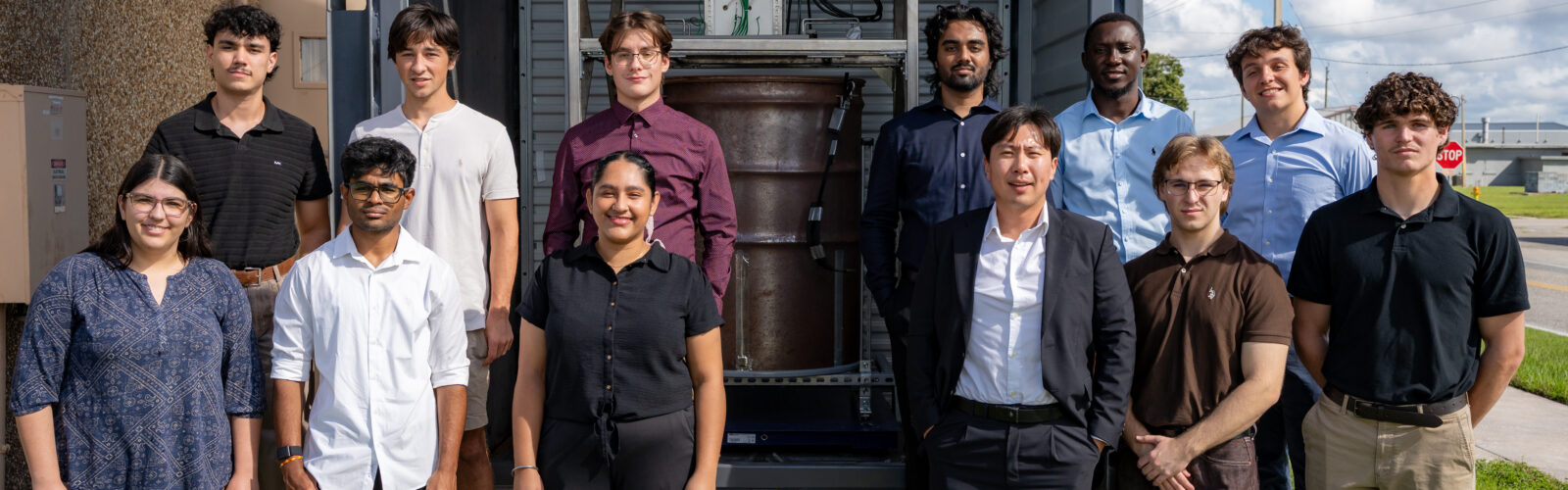
UCF Assistant Professor Shin Young Jeong is part of a team that has created a novel design for a thermal energy storage system that has the potential to overcome these challenges – and was recently recognized for its innovation.
The project, called ENDURING, has received a 2026 R&D 100 Special Recognition: Market Disruptor award from Research & Development World. Three projects were honored with Gold, Silver and Bronze awards and Jeong’s team from the National Laboratory of the Rockies (NLR) received the Silver award.
“It is very exciting and rewarding to be part of the ENDURING team and to see our work recognized with an R&D 100 Award and the Silver Market Disruptor Award,” Jeong says. “This technology represents years of research and development by a very collaborative team, so it is especially meaningful to see the work recognized not only for its technical innovation but also for its potential impact on the energy storage market.”
What makes ENDURING unique is that it can use inexpensive solid materials such as sand to store energy. Typically, energy storage units utilize particles found in batteries such as metal oxides, composites and electrolytes. However, these materials are expensive and can degrade rapidly after repeated charge and discharge cycles.
Sand, in contrast, is inexpensive and can withstand high temperatures. This means the system can store large quantities of energy without relying on battery materials.
“ENDURING provides a fundamentally different approach to long-duration energy storage,” Jeong says. “It combines low-cost storage materials with the ability to scale to very large energy capacities, while also providing flexibility in how the stored energy is ultimately used — as electricity or as high-temperature heat for industry.”
For Jeong, this award is especially meaningful because he started working on the project when he was a member of the NLR. After he joined UCF, Jeong and his research group continued to support the development of the technology.
“This is actually one of the aspects of the project that I find most exciting,” Jeong says. “My role has evolved from working directly on ENDURING as a postdoctoral researcher at NLR to now helping advance the technology through my own research program at UCF. It has allowed us to maintain a strong connection between the national laboratory and the university while continuing to address some of the technical challenges needed to move ENDURING toward larger-scale deployment.”
- Written by Marisa Ramiccio